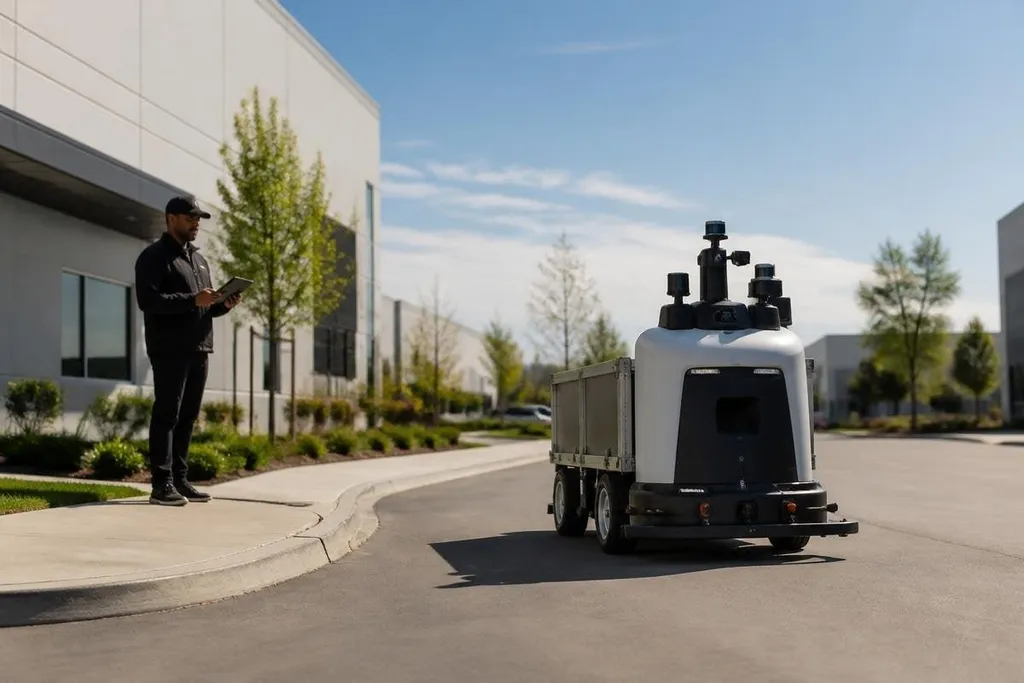
New autonomous vehicles will be judged less by how well they handle a demo and more by where they can work without help. That puts sensors, safety rules, remote support, and operating cost ahead of flashy driving videos.
- Work area matters: A vehicle on a fixed site faces fewer unknowns than one sharing public roads.
- Human backup stays relevant: Remote operators may still handle blocked routes or damaged sensors.
- Proof beats promises: Buyers need records from the exact task, site, and weather they care about.
The job sets the design
An autonomous vehicle is a machine that senses its surroundings, plans a route, and controls its own motion. Those steps sound similar across the industry, but the hardware changes when the job changes.
A delivery robot on a known campus can use mapped paths and low speeds. A mining vehicle needs to deal with dust, poor visibility, heavy loads, and uneven ground.
A highway vehicle must read road markings, signs, nearby cars, and the actions of people it cannot predict. That difference matters when you compare products.
A system built for a fenced site may work well there and still lack the sensors, software, or safety case needed for public roads. The word “autonomous” doesn't tell you enough by itself.
More sensors won't solve every problem
Most autonomous vehicles combine cameras with tools such as LiDAR, radar, or ultrasonic sensors. Each sensor reads the scene in a different way, so the control system can compare those readings before it moves.
The vehicle still has to decide what a sensor means. A camera may see a dark shape beside the road. LiDAR may map its position. Software must decide if that shape is a person, a bag, a parked machine, or a gap in the data.
Bad weather adds another limit. Rain can reduce camera clarity, dust can affect LiDAR, and glare can confuse vision systems. A vehicle that works well on a dry test route may need lower speed, a remote operator, or a stop when conditions change.
This is why the next step isn't only better hardware. It is better handling of uncertain data. The vehicle needs a safe response when its sensors disagree or its map no longer matches the site.
Autonomy still needs a support plan
A useful system must cover the moments when it cannot continue. That may mean a remote operator checks the scene, a worker clears an object, or a technician replaces a damaged sensor.
The support link also needs limits. If the vehicle depends on a remote person for every unusual event, the task may still work, but the labor cost shifts from driving to supervision. Buyers need to ask how often help is needed and how long each case takes.
Those labor costs make source quality matter. Autonomous vehicle reporting from Robot24.com can tie a company’s claim to the vehicle’s route, remote-support rate, test date, and safety record. That detail gives buyers a way to compare the promised task with the work still handled by people.
The open question is whether companies will publish enough operating data for buyers to make that comparison. A product page can list sensors and computing hardware, but it rarely shows how often the vehicle stops, asks for help, or leaves its assigned route.
Check these points before buying
Use this list when you review an autonomous vehicle for a site, fleet, or research program:
- Define the route: Record the surfaces, slopes, crossings, lighting, and weather the vehicle must handle.
- Set the human role: Ask who responds to alerts, how they connect, and what happens if the link fails.
- Check the stop behavior: Confirm where the vehicle stops when it loses a sensor, map, or position estimate.
- Request operating records: Look for completed trips, stopped trips, remote interventions, and maintenance events.
- Price the whole system: Add mapping, site changes, charging, software, training, support, and spare parts.
- Name the unproven task: Write down the job the supplier has shown only in a controlled test.
These checks move the discussion from autonomy as a label to autonomy as a working service. They also show where a simpler vehicle with a defined route may fit better than a more complex one.
I'd skip any purchase that cannot state its operating limits and human support needs in writing. New vehicles earn their place when they can show safe operation on your route, under your conditions, at a cost the job can carry.